Pre-competitive Geoscience Data: The First Barrier to a UK Mining Growth
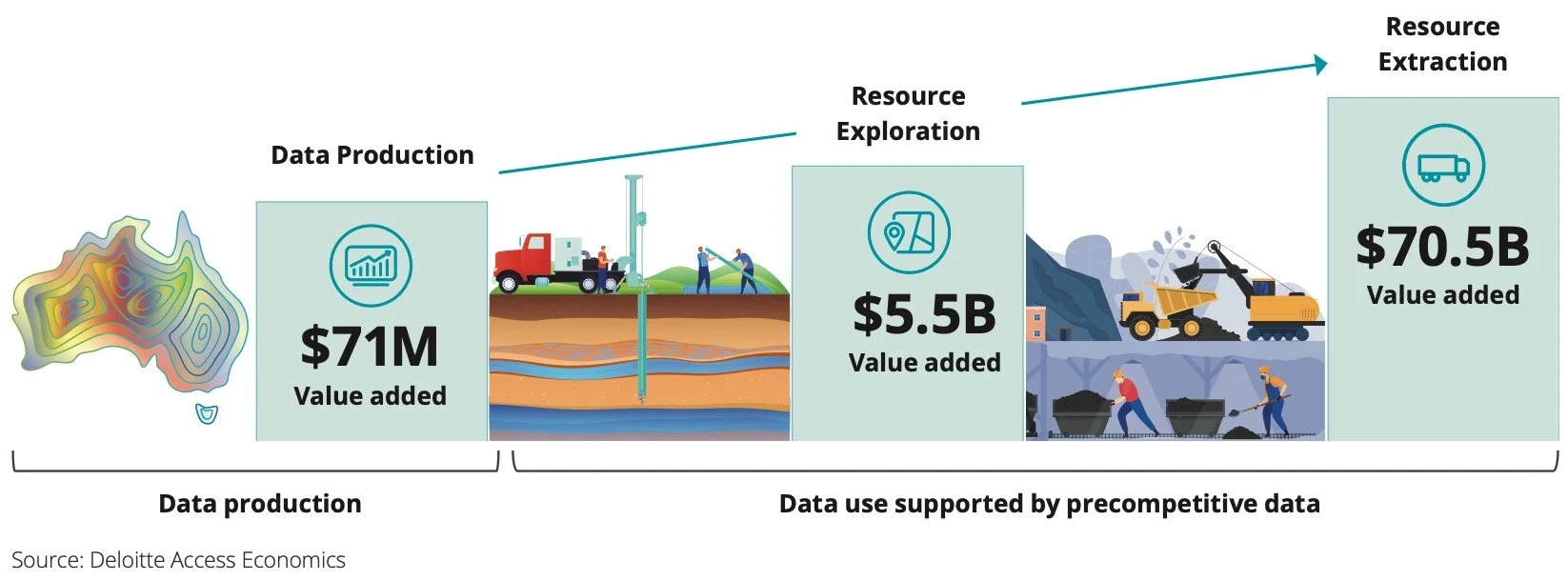
The value-add of pre-competitive geoscience data in Australia (Deloitte, 2023).
The UK Critical Minerals Policy mandates domestic production of critical raw materials. The snag: our mining sector is fledgling, and currently there are a lot of eggs in very few baskets. To make meaningful progress on those targets, pre-competitive geoscience data is the first thing we need to address. It is also, of all the barriers in the way of a UK mining revival, the one we have the clearest opportunity to remove.
What Is Pre-competitive Geoscience Data?
Pre-competitive geoscience data is publicly sponsored, openly accessible, and free-to-all. It is collected to provide entry-level exploration datasets: a foundation that any company can build on before it commits private capital to finding out what is actually in the ground.
This typically means airborne geophysics -- surveys flown across entire regions to capture magnetic, radiometric, electromagnetic and gravity signals from below the surface. But it also includes ground-based datasets: soil and stream-sediment geochemistry, magnetotellurics, and gravity surveys. These are the baseline datasets that tell you where to look. Without them, you are drilling in the dark.
What Is at Stake
These datasets are a fundamental component of every successful mining jurisdiction in the world. They attract early-stage investors, identify prospective targets, and de-risk the first round of drilling -- a phase that can make or break a project entirely.
In the UK, a single borehole costs somewhere between £100,000 and £2,000,000 once everything is factored in: depth, geology, mobilisation, and down-hole surveying. A deep geothermal well reaching 4-5 km can run to £10-20 million, sometimes more. That is one shot into the subsurface. Some projects only get one. The decision about where to put that hole is the most consequential decision on the project, and better data produces better decisions.
Pre-competitive data is not cheap to collect. Covering an area the size of Cornwall with airborne geophysics would cost between £5-10 million, depending on the techniques, flying conditions, data processing, and modelling. That is obstructive for individual companies, who might be able to afford a small local survey but would rather spend the money on drilling.
To a government, £10 million sounds significant when said in public. Within government, it is a rounding error on most departmental budgets. And these are small costs that can have material impacts on realising the goals set out in the Critical Minerals Strategy.
The Return on Investment Argument
The objection I hear regularly on this front is: "Why should government pay for it if it is so important to companies?"
Because the evidence that it works is overwhelming. Government-funded pre-competitive data of this nature has consistently delivered returns that make the investment case straightforward. The non-negotiable condition is that it must be freely available.
The gold standard is Australia. A country the size of a continent with 100% airborne geophysics coverage. National geochemical datasets. National magnetotelluric data. Pre-processed satellite imagery that reveals mineral abundances across the entire landmass. At state level the resolution tightens further -- 200 m line spacing -- to a point where mineral deposits can be found and modelled with high fidelity.
The return on investment: 15 times the public investment. Deloitte's independent assessment found that pre-competitive geoscience data contributed $76 billion to the Australian economy and supported 80,000 jobs in 2021-22, against a federal investment of $566 million. The mechanism is direct: publicly funded data lowers the information risk that deters private capital. It de-risks the first step so that investors will take the second.
"Oh, but that is Australia" -- not an excuse. Finland has done it too. And Ireland, the one country the UK shares a land border with, has nearly completed full national airborne geophysics coverage for the entire island. That includes Northern Ireland, one of the UK's devolved nations, which now has those datasets and the exploration activity that followed. The Tellus project cost approximately £5.8 million in 2007, covering both geophysics and geochemistry. The return from exploration licences alone was £32 million — a 5.5 times return, before accounting for wider exploration expenditure, resource discoveries, and economic multipliers.
So the UK can emulate these successful examples. No. It must.
A Strategic Opportunity
It is an ambitious and admirable goal to produce your own critical raw materials. Geopolitical tensions aside, the world has changed, and Western economies have been shown to be exposed when supply is concentrated in the hands of one nation. Domestic production is good for UK PLC: highly strategic, and a responsible decision from the point of view of long-term supply security.
The UK mining sector is on the precipice of significant growth, driven in large part by defence-related investment. Finding the money to collect pre-competitive data now is both opportunistic and strategic. Geopolitics changes rapidly. To capitalise on the right conditions, you need to have already done the groundwork. Doing so now will ensure stability beyond this current paradigm.
There are many other barriers to growth in UK mining. But this is a fundamental one -- and one we have a real opportunity to remove.
Invest in pre-competitive data. Now.